

How to choose a mining appliance: the complete buying guide
Start with the workload. Compare complete systems, site requirements, seller evidence, and the real cost of ownership.
6 min readRead the guide ↗
Compare ASIC mining appliances by algorithm compatibility, sustained hashrate, wall power, cooling, and support—not a promised payout.
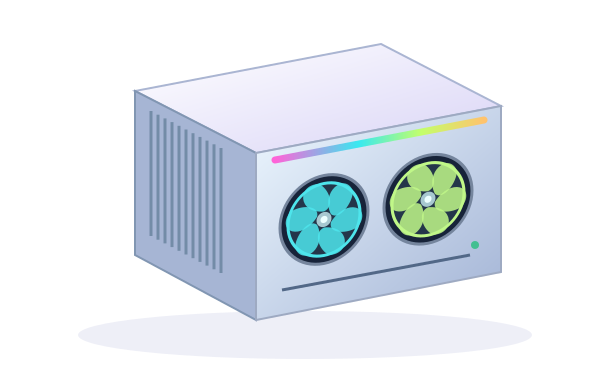
Confirm the exact algorithm and model. A Bitcoin-oriented SHA-256 appliance is not a general-purpose GPU or a universal miner for every network.
Ask for sustained output and power measured over the same interval. Distinguish local activity from accepted pool work and device-only power from site consumption.
Review the model-specific power and cooling requirements. The room, maintenance access, sound, and support arrangement belong in the purchase decision.
An application-specific integrated circuit is specialized hardware. In a Bitcoin mining setup, a compatible ASIC performs repeated hashing work while software prepares and coordinates the work. The surrounding appliance includes more than the chip: controller, power supply, cooling, and the means to connect to a network or pool all matter.
Do not assume that two appliances sharing a product-family name have the same specifications. Ask for the complete model identifier, cooling variant, supported operating modes, and included accessories. Use the hardware comparison to keep specialized hashing separate from GPU and AI workloads.
A hashrate figure without an algorithm or measurement window is incomplete. Request the operating mode, test duration, inlet conditions, wall-power boundary, and any interruptions. Include rejected or unusable work in your review rather than looking only at the highest momentary reading.
For a compatible workload, dividing watts by terahashes per second gives joules per terahash. This calculation is useful only when the power and output measurements describe the same operating interval. It does not by itself establish purchase value or profitability. The electricity guide explains the units with hypothetical examples.
An industrial appliance may be unsuitable for a shared room even when its footprint appears manageable. Check power requirements, airflow direction, clearance, permitted environmental conditions, and service access against the actual manufacturer's documentation. Use qualified professionals for the electrical and mechanical installation.
Keep the complete installation budget visible. Freight, mounting, approved cables, supporting cooling, network equipment, and maintenance can change the decision. An appliance that fits the original sticker-price budget may not fit the installed-cost budget.
Begin commissioning with a supported stock configuration. Record identifying information, firmware, operating conditions, useful output, and the test interval. Save those records away from the appliance itself. A restart or a return shipment should not erase your only baseline.
Before purchase, clarify support responsibility and the process for damaged or faulty equipment. Our buying checklist gives you a structured set of questions to take to the seller, while the Bitcoin setup guide covers commissioning from delivery to accepted work.
Further reading: Bitcoin developer guide: mining ↗
Start with the workload. Compare complete systems, site requirements, seller evidence, and the real cost of ownership.
Specialized hashing or programmable compute? A practical comparison that starts with compatibility, not promises.
Inspect the machine, prepare the site, configure the network, and create a commissioning record you can trust.
Good hardware decisions start with better questions.

